If you spend enough time creating digital art, you eventually notice a pattern.
Not in the work itself, but in the process behind it.
Ideas tend to arrive freely, but execution narrows them down. What starts as something open-ended slowly becomes fixed. A sketch turns into a direction. A direction turns into a style. And once that style is chosen, everything else follows.
Changing course later is possible, but it comes with a cost.
You don’t just adjust the piece. You rebuild it.
That’s been the quiet constraint behind most digital workflows.
Style Has Always Been a Commitment
Every artist knows this moment.
You decide how something should look before you fully explore what it could be.
Photorealistic or stylized. Painterly or graphic. Soft or high contrast.
Once that choice is made, the rest of the work aligns around it. The character, the lighting, the composition, everything becomes tied to that decision.
If you want to reinterpret the same idea in a different style later, you’re not editing anymore. You’re starting over.
That’s not just a technical limitation. It shapes creative thinking.
Identity Doesn’t Translate Easily
One of the hardest parts of moving between styles is maintaining identity.
A character that feels strong and recognizable in one format can lose that clarity in another. Subtle differences in structure, expression, or proportion start to accumulate.
Even experienced artists deal with this.
They redraw, refine, and adjust repeatedly to preserve consistency. It works, but it takes time and attention that could otherwise be spent exploring new ideas.
This is where cross-style face swap begins to change things.
Identity Becomes Transferable
Instead of rebuilding identity every time, it can now move across styles.
Not as a rigid copy, but as something that adapts.
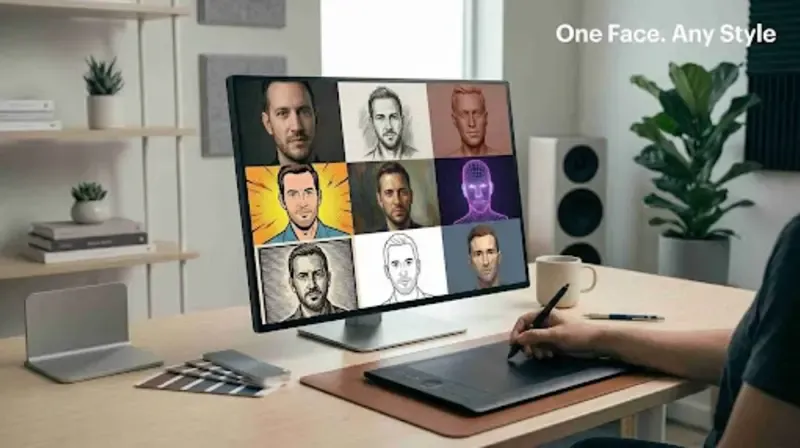
When using Face Swap, the identity of a subject is interpreted within the context of the target style. It doesn’t sit on top of the image. It adjusts to it. Lighting, tone, and texture shift in a way that aligns with the surrounding visual language.
That distinction is what makes it usable for creative work.
Higgsfield Face Swap doesn’t treat identity as a static layer. It treats it as something that belongs inside the composition.
You Don’t Have to Lock the Style Early
This changes how artists approach the beginning of a piece.
Instead of committing early, you can explore first.
A concept can start in a loose direction and evolve into multiple styles without losing coherence. A portrait can move from realism into illustration. A stylized piece can shift toward something more grounded.
The identity holds.
That freedom changes the pace of decision-making.
You don’t have to get it right the first time.
Exploration Becomes Part of the Workflow
Artists have always experimented.
But experimentation often comes with friction.
Trying a different style usually means reworking the piece. Under deadlines, that becomes difficult to justify. So ideas get filtered early, not because they’re weak, but because they’re time-consuming.
Cross-style face swap reduces that friction.
With Higgsfield Face Swap, variations can be explored without rebuilding the entire structure. The base identity remains consistent, which makes it easier to compare directions and refine concepts.
Exploration becomes practical, not just theoretical.
Consistency Without Repetition
Maintaining consistency across multiple pieces has always required discipline.
You redraw the same character. You adjust proportions carefully. You try to match expressions across different contexts.
Even then, small variations appear.
Cross-style face swap introduces a different kind of consistency.
Instead of recreating identity manually, it allows identity to persist across variations.
Higgsfield Face Swap supports this by keeping key features stable while adapting to different styles. The result feels aligned, even when the visual language changes.
For artists working on series, campaigns, or narrative projects, this can simplify one of the most demanding parts of the process.
The Role of the Artist Shifts Slightly
Every tool changes where effort is applied.
This one is no different.
Instead of focusing on reconstructing identity across styles, the focus shifts toward direction. You decide how something should feel, how it should evolve, how different versions should relate to each other.
The technical work of adapting identity becomes less manual.
Higgsfield Face Swap handles that layer, allowing artists to spend more time on composition, storytelling, and style.
It doesn’t replace skill.
It redistributes it.
It’s Not About Replacing Craft
There’s always a concern when new tools enter creative workflows.
Will they replace traditional skills?
In this case, the answer is more nuanced.
Cross-style face swap doesn’t generate ideas. It doesn’t define style. It doesn’t make creative decisions.
It operates within those decisions.
Higgsfield Face Swap becomes part of the process, not a substitute for it. The artist still controls the outcome. The tool simply reduces the friction involved in getting there.
Ethical Context Is Becoming More Relevant
As identity becomes more flexible, the conversation naturally expands.
Questions around usage, ownership, and representation become more important.
This is especially true in the context of synthetic media.
Organizations like Partnership on AI are actively working on frameworks around the responsible use of synthetic media, focusing on how these technologies should be developed and applied.
For artists, this doesn’t limit creativity.
It adds awareness.
Understanding the implications of how identity is used becomes part of the craft.
From Fixed Pieces to Adaptive Systems
The bigger shift is not just technical.
It’s conceptual.
Digital art is moving away from fixed outputs toward adaptive systems.
A single concept can now exist in multiple forms. Each version can serve a different purpose while still feeling connected to the original idea.
Higgsfield Face Swap supports this by allowing identity to remain stable as everything else evolves.
That turns one piece into many, without losing coherence.
Why This Matters Now
The expectations around digital content are changing.
Artists are asked to produce more, adapt faster, and work across different formats.
Traditional workflows struggle to keep up with that pace.
Cross-style face swap offers a way to manage that complexity.
Not by simplifying creativity, but by simplifying execution.
Conclusion
Cross-style face swap doesn’t redefine art.
But it does change how art moves.
Identity is no longer locked to a single style. It can evolve, adapt, and exist across multiple visual directions without losing its core.
Higgsfield Face Swap reflects this shift by making identity transferable rather than fixed.
For digital artists and illustrators, that opens up new ways of working.
More exploration. More consistency. Less friction.
And in a space where ideas move faster than ever, that flexibility matters.