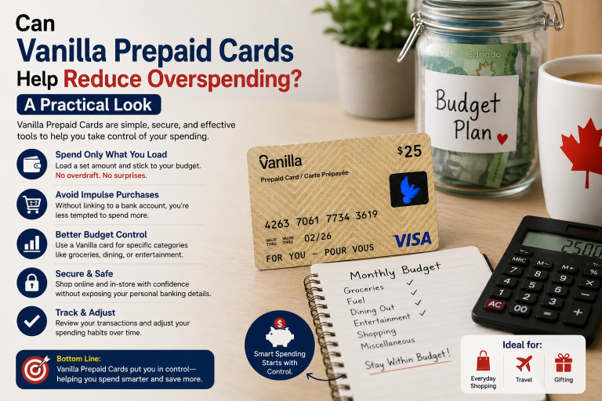
Overspending is one of the most common financial struggles people face today. Between one-click checkouts, tap-to-pay convenience, and the ever-present temptation of credit, it’s easy to spend more than intended without even realizing it. For anyone looking to rein in their spending habits, prepaid cards, like the Vanilla prepaid Mastercard, offer a simple, fixed-balance alternative to traditional credit and debit cards. But do they actually help curb overspending, or are they just another payment option?
This article takes a practical look at how Vanilla prepaid cards work, why spending limits matter for budgeting, and what to realistically expect if you’re using one to build better money habits.
What Is a Vanilla Prepaid Card?
A Vanilla prepaid Mastercard is a card you load with a specific amount of money upfront. Once that balance is loaded, you can spend it anywhere Mastercard is accepted, in stores, online, or over the phone, until the funds run out. There’s no line of credit involved, no monthly bill, and no borrowing against future income.
This makes it fundamentally different from a credit card, where you can spend beyond what you currently have and pay it back later (often with interest). It also differs from a debit card, since it isn’t tied to a bank account; the balance exists only on the card itself. For anyone wanting a clear, contained way to spend, this structure is worth understanding before deciding if it fits your budgeting style.
Why Spending Limits Matter for Budgeting
One of the biggest challenges with overspending is that many payment methods don’t create a natural stopping point. Credit cards, in particular, can make spending feel limitless, the credit line often exceeds what someone can comfortably repay, and the consequences aren’t felt until the bill arrives.
Prepaid cards work differently. Because the balance is fixed, there’s a built-in limit that can’t be exceeded. Once the funds are gone, the card won’t work for further purchases. This creates a psychological shift: instead of asking “can I afford this on credit?”, the question becomes “do I have enough left to cover this?”
This kind of built-in constraint is often used for:
- Gift-giving, where a set amount is meant to be the total spend
- Allowances for teens or dependents learning to manage money
- Online shopping, where it’s easy to lose track of running totals
- Travel budgeting, where a fixed amount can help avoid vacation overspending
Practical Ways Prepaid Cards Support Spending Control
Preventing impulse overspending.
Once the balance reaches zero, the card ceases to function, so there is no way to say, “just add it to the bill.The card becomes inoperable as soon as the balance goes down to zero, so there is no way to say, “just add it to the bill. This can help to prevent impulsive buying.
Charging the cost of each purpose on a separate budget and charging each purpose separately.
Some people manage to have several cards for different activities – one for groceries, one for entertainment, one for subscriptions, etc. Such a separation, visually and physically, can help to position the focus on where the funds are actually being directed.
No interest or debt liability.
As there is no credit line, there is no risk of credit card charges or getting into debt using the card. What you put in, you get out.
Good for certain spending requirements.
A monthly entertainment allowance or a cap on how much you can spend on online purchases, prepaid cards can serve as a helpful limit for those discretionary spending categories that can run out of control.
A tool to develop financial discipline.
Prepaid cards can be a way for students, young adults, or anyone who is looking to improve their spending habits to practice a key element of budgeting: sticking to a budget.
Limitations to Keep in Mind
Prepaid cards are not an ideal product, and the only reason to consider using one as a main budgeting tool is to understand the flaws in it.
- They do not help to build credit. Because there is no borrowing or repayment with prepaid cards, they will not positively affect a credit score.
- Fees may apply. Some cards have activation fees or other fees, so check the terms before depositing any money.
- They are best used in combination, rather than as a stand-alone approach. A prepaid card can help with a budget, but it’s not a substitute for financial planning.
- Reloading habits matter. The “spending cap” effect can be reduced if the card is reloaded often without being tracked. If you don’t use it on purpose, the card can do little to curb spending.
Tips for Using a Vanilla Prepaid Card to Curb Overspending
If you’re considering a prepaid card as part of your budgeting approach, a few habits can make it more effective:
- Load only what you plan to spend for a specific purpose or time period; avoid topping it up “just in case.”
- Check your balance regularly so you always know what’s available before making a purchase.
- Use it for discretionary spending only, such as dining out, entertainment, or online shopping, rather than essential bills.
- Avoid frequent reloading. Treat the card similarly to a cash envelope; once it’s empty, that spending category is done for the period.
- Pair it with a broader budget, whether that’s a simple spreadsheet or a budgeting app, so the card fits into your full financial picture rather than existing in isolation.
Who Benefits Most From This Approach
This method tends to work particularly well for budget-conscious shoppers who want firmer boundaries around discretionary spending, people trying to reduce dependency on credit cards, parents managing allowances or teaching teens about money, and anyone giving a gift where a controlled, specific amount is the intention.
Conclusion
A Vanilla prepaid Mastercard isn’t a magic fix for overspending, but its built-in balance cap offers a genuinely practical way to create spending boundaries, something many other payment methods lack. Used thoughtfully, alongside a broader budgeting habit, it can be an effective tool for anyone looking to spend more intentionally and avoid the slippery slope of unchecked credit use.